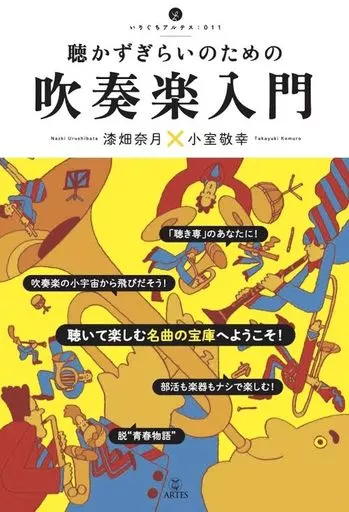
Book (Practical) Music Introduction to Brass Band Music for Listening Puzzles / Natsuki 漆畑 / Keiko KOMURO


Product description ※Please note that product information is not in full comprehensive meaning because of the machine translation.
Music
[Content introduction]
Welcome to the treasure house of famous songs you can enjoy listening to!
Its origin, import history, Japanese composers --
An epoch-making guide that talks about the charm of brass band music is born!
Carefully selected 50 songs that have been played and loved all over Japan.
They are divided into an imported (overseas) edition and a domestic (Japan) edition and introduced.
From the classic songs by Horst, Reed and Bin Kaneda to the latest works by
Tikeri, J. L. Mackie and Miho Hasama,
we will delve into the characteristics and profiles of the composers, listening points / blowing points of the songs,
positioning in the competition, etc.
It traces the history of the brass band that came to Japan as a military band until it became established as a club activity.
It is also complete with CD guide, column, playlist and index.
Natsuki 漆畑, who loves brass band music from the bottom of his heart, and Takayuki Komuro, a music writer who is active across genres, have an appeal to music lovers who don't play musical instruments.
This is an epoch-making guide to brass band music.
You can talk about the charm of brass band music in a hot, deep, and deep way.
Now available!
◎ From the table of contents of this manual
INTRODUCTION Wind Instrument Escape from an Island Nation
Part 1 Military Band as プリクエル (The Tale of the Previous Day)
1 Hired Foreigners and ジャパナイズ (Japanized)
2 Military Band Pre-War, Wartime, and Post-War
3 Band Directors and Americanized
Part 2 Imported Music Competition Performance History
1 50 s : Wind Instrument as Music for Enjoying Performance
2 60 s : Is Wind Instrument Classic?
370 s : Low is lower, high is higher
4 80 s : To win in an intensifying competition
5 90 s : Why there are so many titular music in brass
6 2000 s : How far can we go?
Part 3 : The History of Composition and Arrangement by Japanese Composers
1 : The Genealogy of the "Ethnic Group" and Connection to Brass Band Music
2 : The Academy of the Arts and the Talented Arranger
3 : The Transition from a Wind Instrument Player to a Composition and Arranger
4 : The Significance and Merits and Demerits of Amateur Composers
5 : Why did the star of the competition become a Japanese composer?
6 Composers expanding their range from the viewpoint of the field
7 New scenery opened by "Brass Band Pops"
What is the future of POSTSCRIPT brass band?
[CD Guide] [Columns] [Playlists]
[Names of People and Groups] [Titles of Songs]
◎ Major songs covered in this book
[Famous Songs Imported from Europe and the United States]
March <
Overture <
[Contents]
INTRODUCTION Brass Band Escape from an Island Nation
Part 1 Military Band as プリクエル (The Tale of the Previous Day)
1 Employed Foreigners and ジャパナイズ (Japanization)
What kind of music is brass band in the first place?
Import of European Music Started with the Military Band
The nation was also born with the Military Band!
Imported Repertory While Japanizing
2 Military Band as a Place to Learn Music Before, During, and After War
Military Band as a Place to Learn Music
War and Brass Band
De-National Prestige
What does the Self-Defense Force band do?
3 Band Director and Americanize
Resuming and changing the contest
Americanize As Leader Norio Akiyama
Band Director = Conductor? Are Fennel and Reed band directors?
Part 2 : History of Imported Music Competition
1 50 s : Wind Music as Musical Entertainment
-- From Military Band to Amateur Band
March <
Musical Story <
Overture <
2 60 s : Is Wind Music Classic?
-- Differences between classical and brass band composers
<
<
<
<
3 70 s : The low is lower, the high is higher
-- What is the "grade" of brass band?
<
Overture <
<
<
4 80 s : To Win in an Intensifying Competition
-- Music Sought for Competitive Brass Band
<
<
<
5 90 s : Why Wind Music Has Many Titles
-- Expanded Worldview and Sound
<
<
Symphony No. 1 <<
<
6 2000 s : How far can we pursue our possibilities?
-- Music imported after increased self-sufficiency
<
<
Symphony No. 2 <
Symphony <
Part 3 : History of Composition and Arrangement by Japanese Composers
1 Lineage of "Ethnic" and Connection to Wind Music
<
<
<
<
<
3 Transition from a wind instrument player to a composer and arranger
<
<
3 Bugaku from a wind instrument player <
<
4 Significance and merits and demerits of amateur composers
<
March <
<
5 Why did the star of the competition become a Japanese composer? Watanabe Kushida Bin Kaneda Kumikyoku
<
<
<
6 Composers expanding their horizons from a field perspective
Tone poem for Wind Ensemble <
<
Oversong <
<
7 "Wind Music Pops" opens a new scene
シンコペーテッド March <
Symphony Poem for Wind Ensemble <
<
<
<
What kind of future does POSTSCRIPT wind music have? Sotsu
[CD Guide]
(1) Pre-war and wartime wind music (Part 1)
(2) Post-war wind music composed by foreign composers (Part 2)
(3) Post-war wind music composed by Japanese composers (Part 3)
[Column]
1 The present state of the world's military bands
2 What is "art"? What is "classical music"? -- Re-define
3 Masterpieces that are rarely featured in competitions
4 Works other than wind music that are likely to become wind music
Playlist information
Personal and Group Name Index
Track name index
Author's brief history
Born in Shizuoka Prefecture in 1985. After spending six years of junior and senior high school in brass band music, he studied music education at the Graduate School of Tokyo University of Music after working at two music universities. He studied wind music in general under Yoshio Nakahashi. After that, while working as a planning, accounting and public relations officer at a public cultural facility, he continued his hobby of listening to various wind instrument competitions nationwide under the name of field work. (1 company) He was a member of the Japan Society for Kanuchi and Brass band.